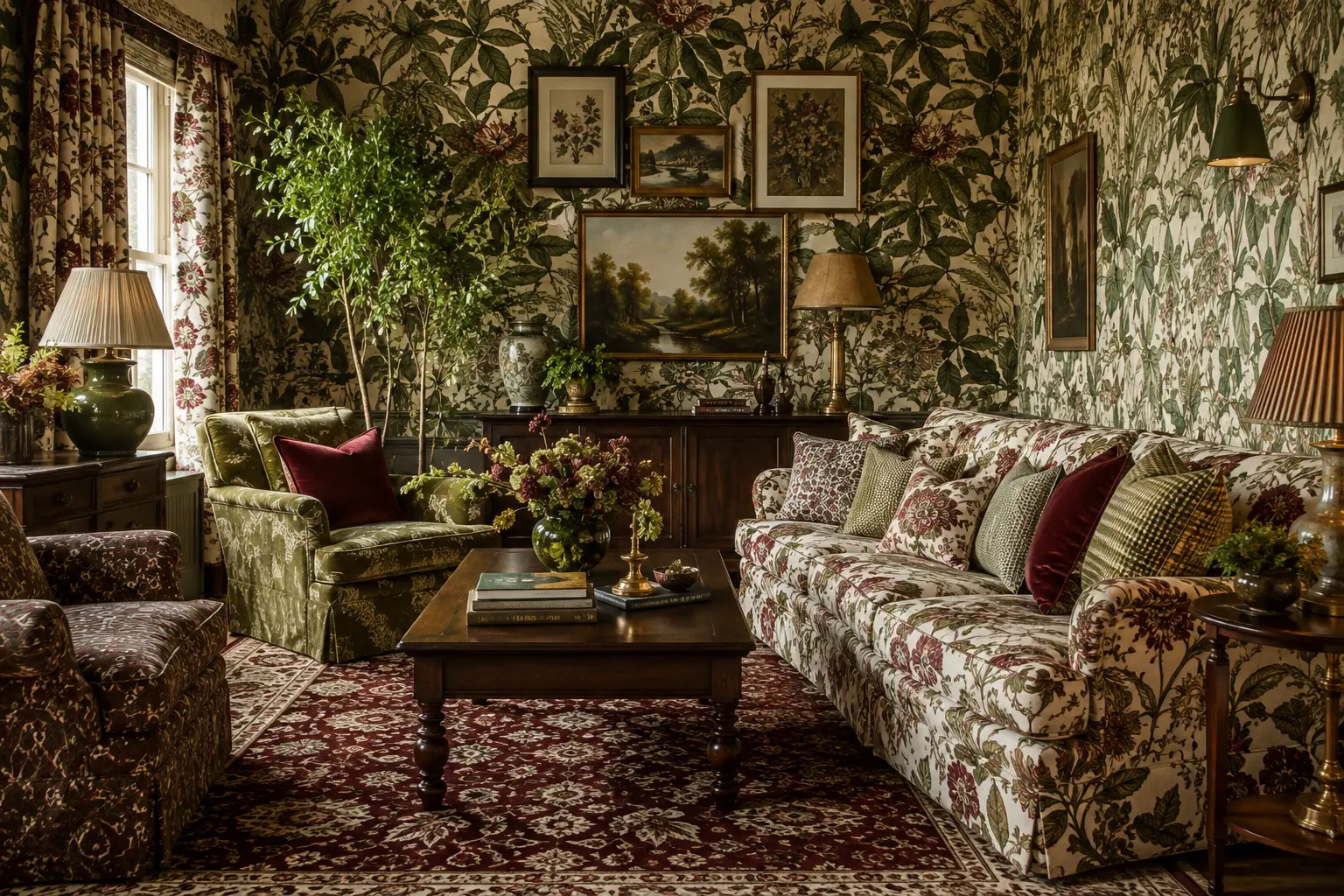
If you’ve ever looked at a beautifully decorated room and wondered why it feels so much more interesting than a space with a single statement wall, the answer may be pattern drenching.
Instead of treating pattern as a small decorative accent, this approach allows it to spread throughout the room. Wallpaper can meet patterned curtains. A floral sofa can echo artwork on the walls. A striped rug can introduce another scale while cushions pull colors from the wallpaper.
The result is layered, immersive, and full of personality.
And here’s the exciting part: you don’t need a huge home or an unlimited decorating budget to make it work.
Pattern drenching can be adapted to a grand dining room, a tiny powder room, a cozy bedroom, or even a narrow hallway. The secret is controlling the relationship between color, scale, texture, and repetition.
The broader design world is already moving in this direction. Architectural Digest has highlighted the return of all-over pattern alongside color drenching and maximalist interiors, while designers continue to experiment with rooms where walls, furniture, textiles, and architectural details become part of one cohesive visual story.
Let’s look at how you can bring the look home.
For more Maximalist interiors Eclectic Maximalism style Examples To Embrace This Amazing Trend!, Maximalist Dining Room Decor.
Table of Contents
What Is Pattern Drenching?
Pattern drenching is a decorating technique where patterns are used generously across multiple surfaces and furnishings within the same room.
Rather than having:
- Plain walls
- One patterned chair
- A neutral rug
- A few decorative cushions
you create a stronger visual connection between several elements.
For example, imagine a bedroom with:
- Floral wallpaper
- Floral or botanical curtains
- A patterned upholstered headboard
- A vintage-inspired rug
- Decorative cushions in coordinating prints
- Artwork that repeats the same color family
The patterns don’t necessarily need to match exactly.
In fact, they shouldn’t.
The goal is coordination rather than duplication.
Think of it like putting together an outfit. Your shoes, bag, coat, and accessories don’t need to have exactly the same pattern. They simply need to look like they belong together.
That principle is what keeps pattern drenching sophisticated instead of overwhelming.
Pattern Drenching vs. Color Drenching
The two techniques are related, but they aren’t identical.
| Pattern Drenching | Color Drenching |
|---|---|
| Focuses on repeated prints and motifs | Focuses on one dominant color |
| Uses wallpaper, fabrics, rugs, artwork, etc. | Uses one hue across multiple surfaces |
| Can include multiple patterns | Usually uses one color family |
| Creates visual movement | Creates visual continuity |
| Works beautifully with maximalism | Can feel minimalist or maximalist |
You can also combine both.
For example, a deep olive-green bedroom could feature green botanical wallpaper, green patterned curtains, green upholstery, and green accessories.
That’s where the room becomes especially immersive.
Color drenching itself has been increasingly associated with the move away from stark neutral interiors toward richer, more enveloping spaces.
How to Choose a Pattern Palette
Before buying five different patterned fabrics, choose your color story.
A simple formula is:
60% dominant color + 30% secondary color + 10% accent color.
For example:
| Role | Color |
|---|---|
| Dominant | Warm olive |
| Secondary | Cream |
| Accent | Burgundy |
Now you can choose florals, checks, stripes, geometrics, and botanical motifs that contain at least one of those colors.
This creates cohesion.
You should also mix pattern scales.
Try:
- One large-scale pattern
- One medium-scale pattern
- One small-scale pattern
- One subtle texture
This prevents every print from competing for attention.
1. Pattern-Drenched Living Room
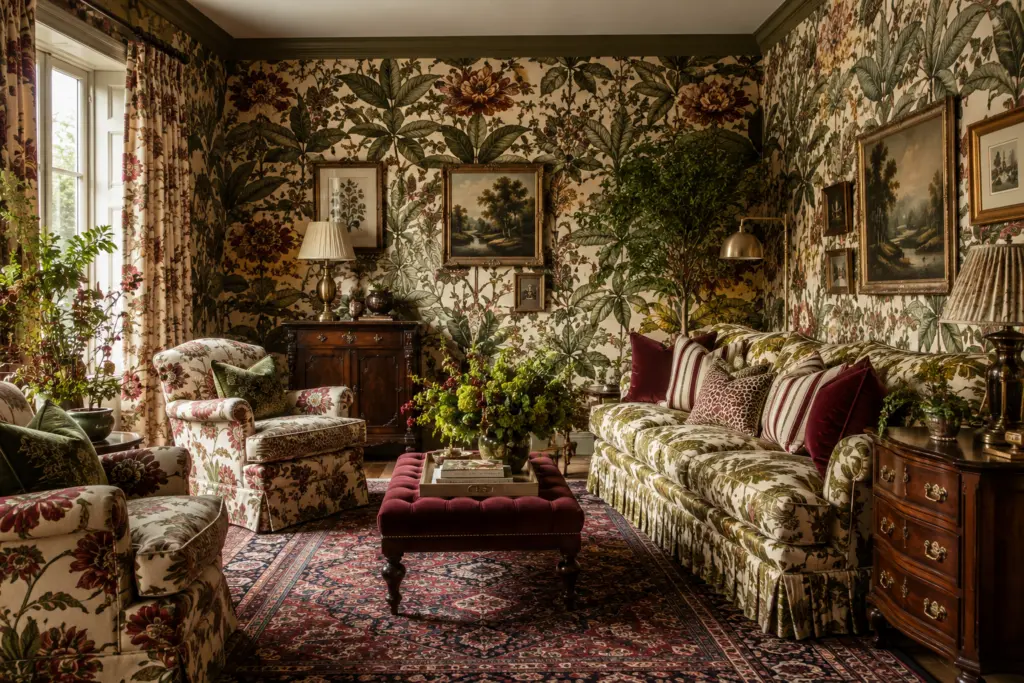
The living room is one of the best places to experiment with pattern drenching because it naturally contains many layers.
Start with a statement wallpaper.
A botanical print, traditional floral, oversized stripe, or painterly design can become the foundation.
Then pull two or three colors from the wallpaper into the furniture.
A patterned sofa can work beautifully, but you can also keep the sofa relatively simple and introduce pattern through:
- Armchairs
- Curtains
- Cushions
- Ottoman
- Area rug
- Lampshades
- Artwork
Don’t forget the ceiling.
A painted ceiling in one of the wallpaper’s secondary colors can make the room feel intentionally designed from top to bottom.
For a sophisticated 2026 look, consider earthy greens, tobacco, burgundy, warm brown, ochre, or smoky blue. These richer colors align with the broader move toward deeper, more expressive interiors.
Design trick: Keep the largest furniture pieces in related tones rather than introducing completely unrelated colors.
That gives your patterns room to shine.
2. Pattern-Drenched Bedroom
Bedrooms are practically made for pattern drenching.
The goal here isn’t necessarily drama.
It’s atmosphere.
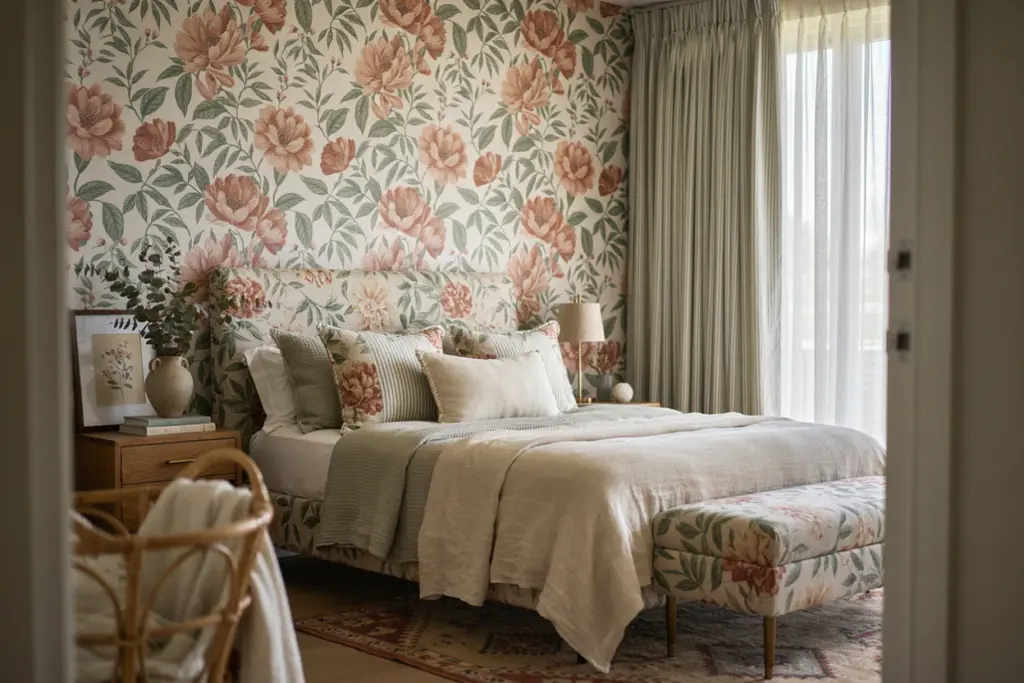
Imagine waking up surrounded by soft floral wallpaper, a patterned headboard, coordinating curtains, a vintage-style rug, and layers of cushions.
For an elegant look, choose one dominant motif and support it with quieter patterns.
For example:
Large floral wallpaper + small floral cushions + thin stripe curtains + subtle geometric rug.
The colors connect everything.
You can also use the same fabric on multiple elements.
A patterned fabric could appear on:
- Curtains
- Headboard
- Bench
- Decorative cushions
This technique creates an especially polished designer effect.
If you’re nervous about going all in, start with a small bedroom or guest room.
It’s easier to experiment there than in the main living space.
3. Pattern-Drenched Dining Room
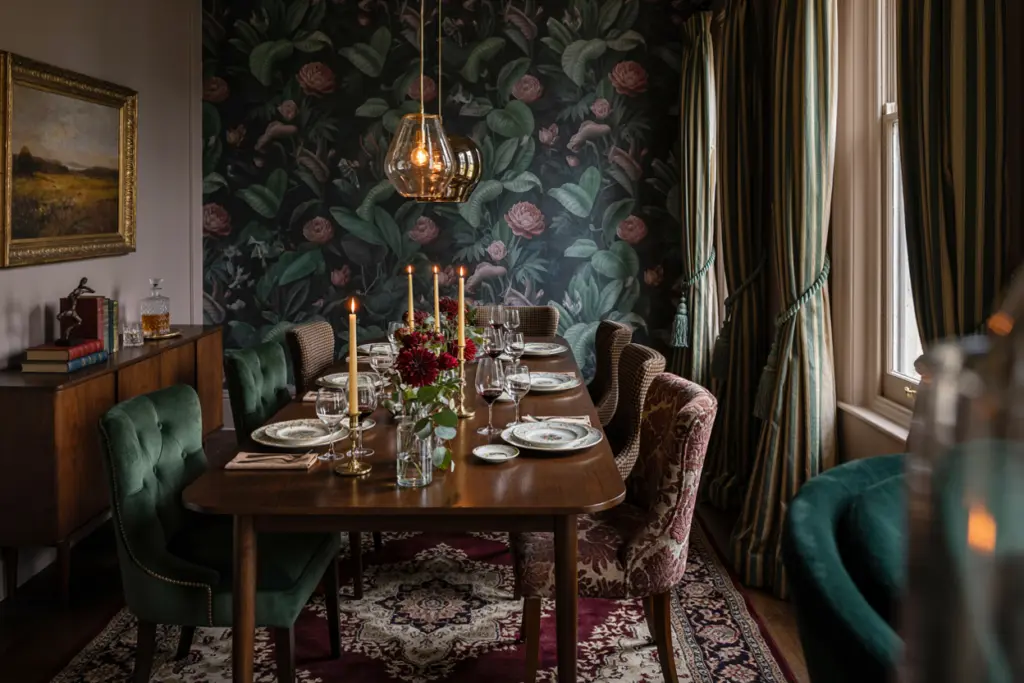
Dining rooms are excellent candidates for dramatic decorating because they don’t need to remain visually neutral.
A richly patterned wallpaper can create an instant backdrop for dinner parties.
Try combining it with:
- Dark wood furniture
- Patterned dining chairs
- Vintage artwork
- A decorative pendant
- Patterned drapes
- A statement rug
For a classic look, combine floral wallpaper with checks or stripes.
For something more contemporary, pair abstract wallpaper with curved furniture and sculptural lighting.
Don’t be afraid of darker colors.
A deep burgundy, chocolate brown, forest green, or navy background can make a dining room feel intimate and sophisticated.
The trick is to balance the darkness with warm lighting and reflective accents.
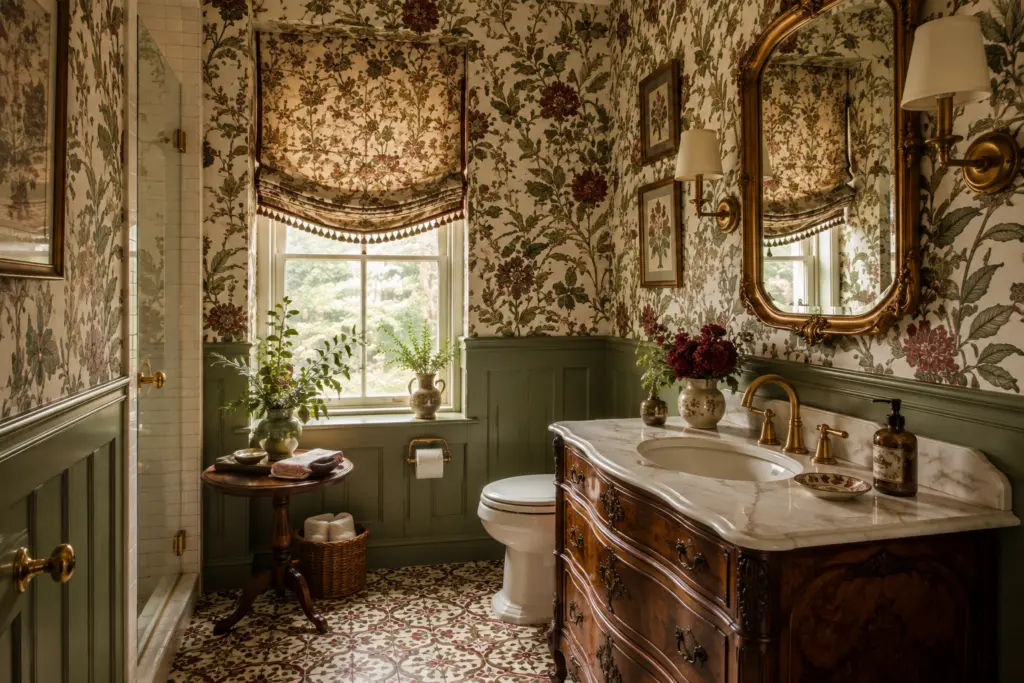
4. Pattern-Drenched Bathroom
Bathrooms are often overlooked when it comes to decorative pattern.
That’s a missed opportunity.
A bathroom can become one of the most memorable rooms in the home because it’s usually smaller and separated from the main living areas.
You can therefore take bigger risks.
Try:
- Patterned wallpaper above wainscoting
- Decorative floor tiles
- Patterned shower curtains
- Floral window treatments
- Printed towels
- Vintage-inspired artwork
Material drenching is another related direction in which the same material extends across multiple surfaces. Architectural Digest has highlighted this approach as a way of creating an immersive, sculptural bathroom experience.
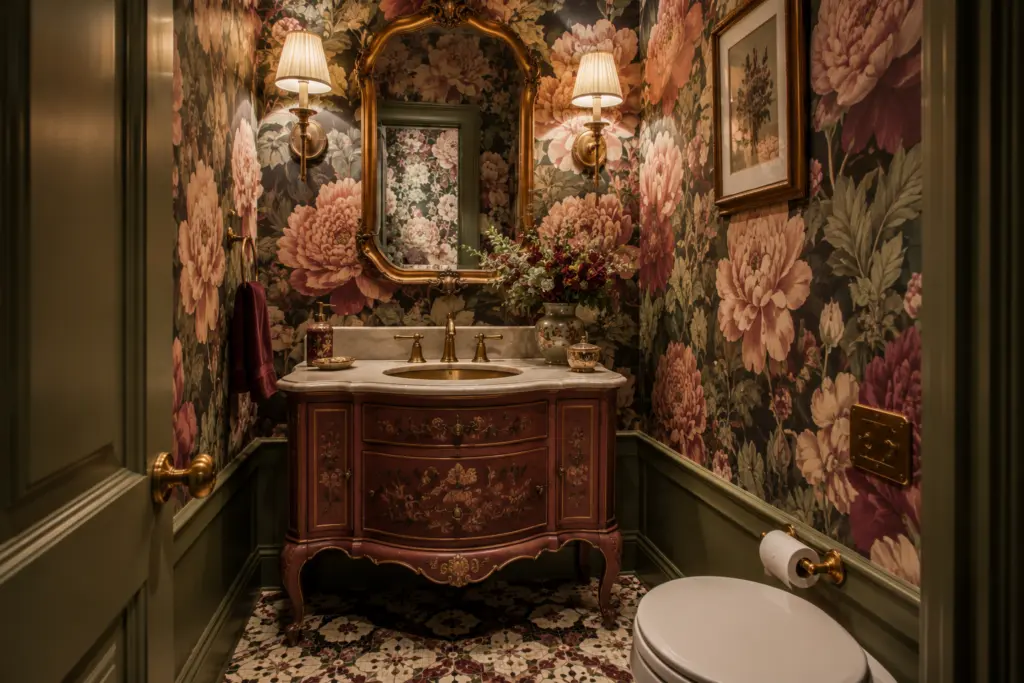
5. Pattern-Drenched Powder Room
If you’re afraid to use pattern throughout your home, start here.
The powder room is your design playground.
Because it’s small, you can afford to be much more adventurous.
Cover the walls in an oversized floral print.
Then add:
- A patterned Roman shade
- Decorative mirror
- Colorful vanity
- Patterned floor
- Vintage brass-style fixtures
- Artwork
You can even repeat the wallpaper pattern in a framed print.
The room doesn’t need to coordinate perfectly with your living room.
In fact, a little surprise can make it more memorable.
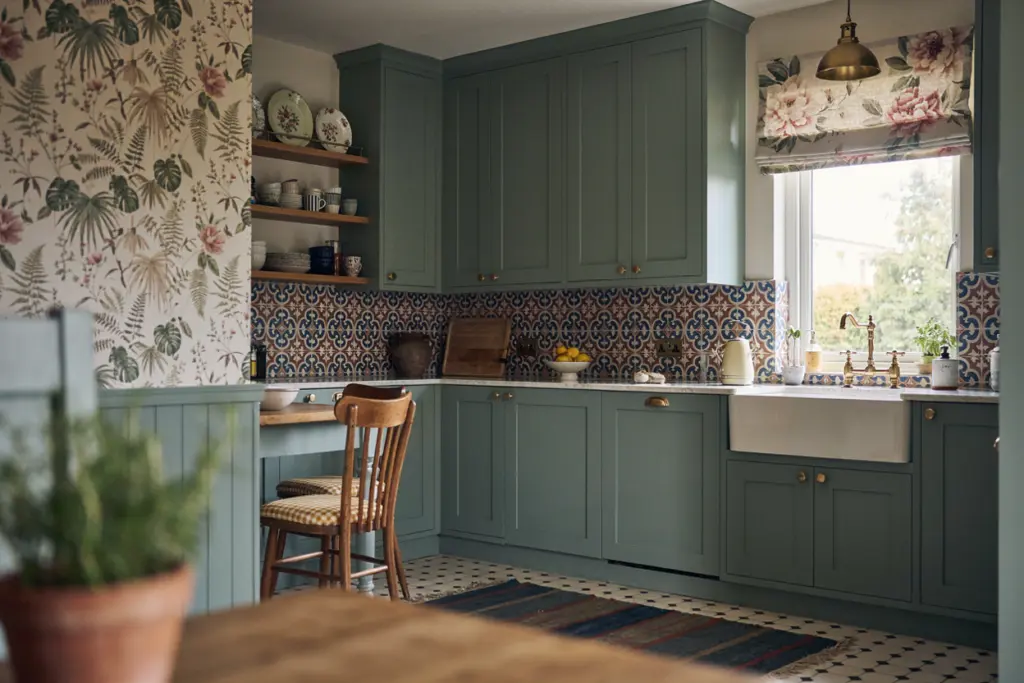
6. Pattern-Drenched Kitchen
Kitchens require a little more restraint because they’re hardworking spaces.
Still, pattern can bring enormous personality.
Consider patterned backsplash tile paired with:
- Printed Roman shades
- Patterned seat cushions
- Decorative dishware
- Vintage runners
- Wallpaper on one wall
- Painted cabinetry
A floral Roman shade can soften a kitchen dominated by hard surfaces.
Alternatively, a small-scale checkerboard floor can provide structure beneath colorful cabinets.
If your kitchen already has strong materials such as marble or natural wood, choose patterns that complement those materials rather than fighting them.
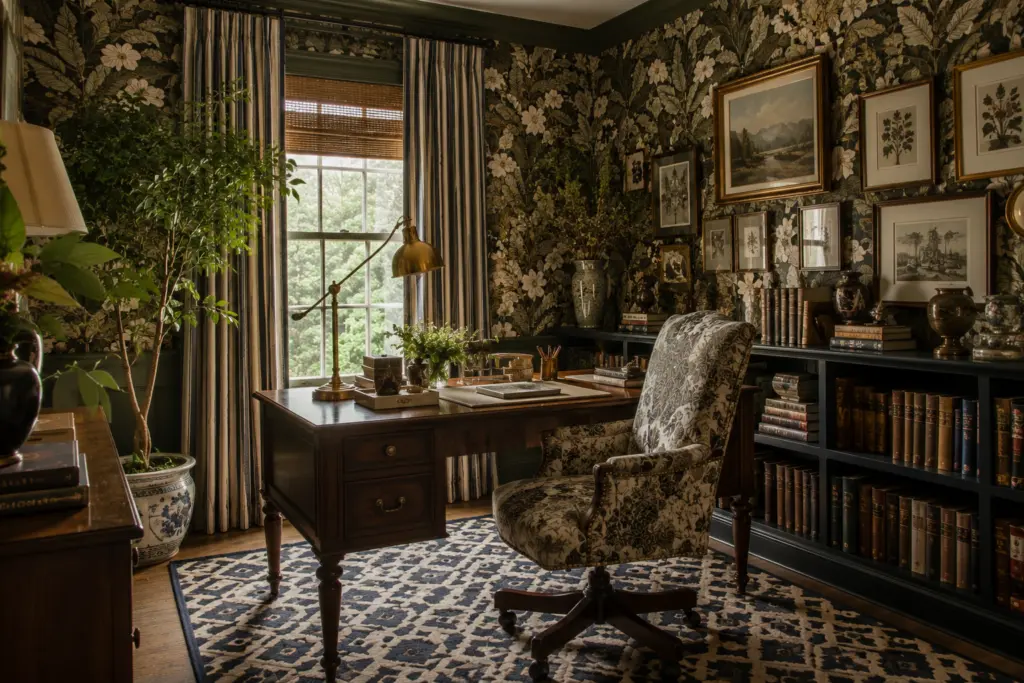
7. Pattern-Drenched Home Office
Your office doesn’t have to look like a corporate cubicle.
A pattern-drenched office can feel creative, warm, and personal.
Choose wallpaper that energizes you without being distracting.
Then add a patterned chair, rug, curtains, and artwork.
For productivity, consider colors such as:
- Muted green
- Dusty blue
- Warm terracotta
- Soft mustard
- Deep brown
If the wallpaper is busy, use a simpler desk.
If the desk is visually dramatic, choose a quieter pattern on the surrounding surfaces.
The idea is to create stimulation without visual chaos.
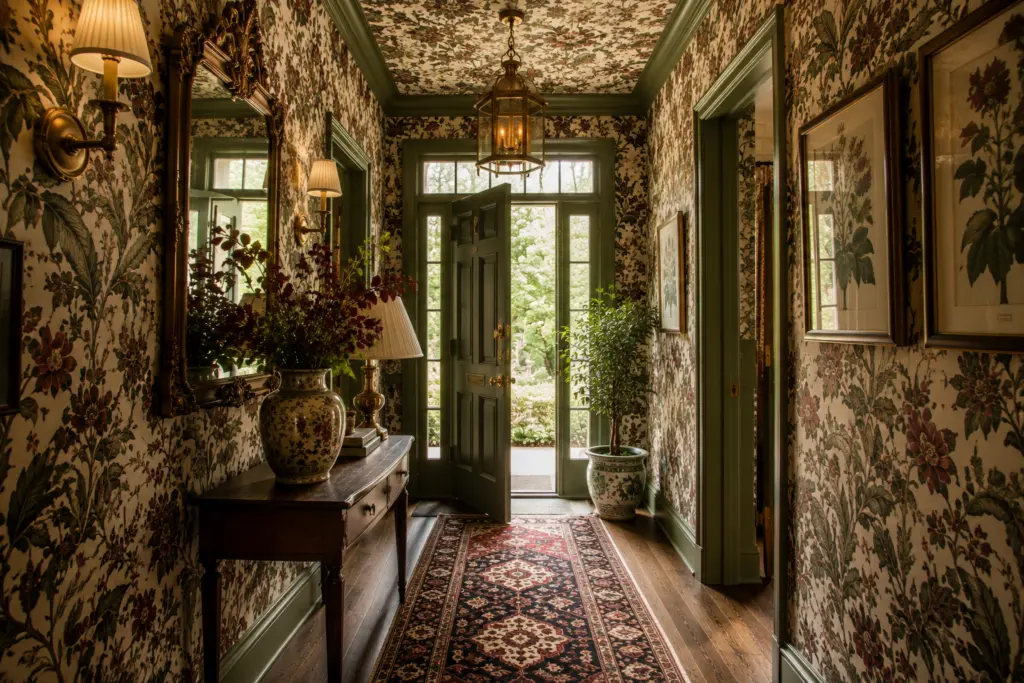
8. Pattern-Drenched Entryway
Your entryway establishes the mood for the entire home.
Why not make it unforgettable?
A narrow entrance can handle a surprisingly bold design.
Try wallpaper that extends across:
- Walls
- Ceiling
- Door surrounds
- Trim
Then introduce a patterned runner.
A small console can hold decorative objects in colors pulled from the wallpaper.
This approach is particularly effective in older homes with architectural details because pattern can visually unite moldings, doors, and walls.
Color drenching is similarly effective in hallways and staircases because these transitional spaces can handle stronger visual treatments.
9. Pattern-Drenched Hallway
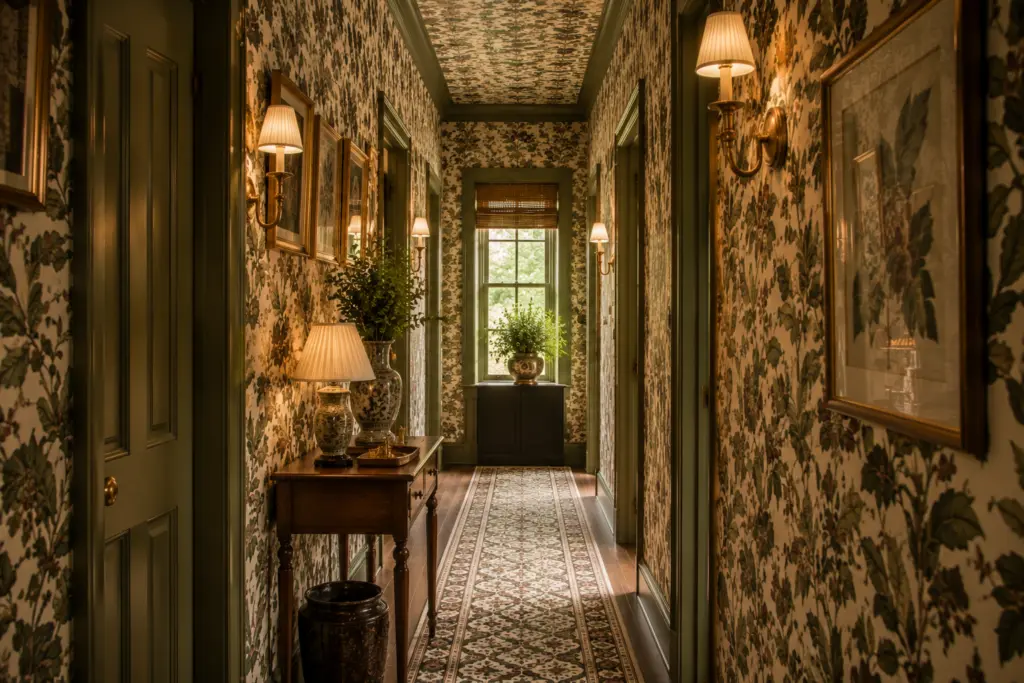
Hallways are often treated as leftover space.
Don’t do that.
A hallway can become one of the strongest design moments in your home.
Use wallpaper with a repeating motif and pair it with:
- Patterned runner
- Gallery wall
- Decorative lighting
- Painted doors
- Coordinating trim
For a narrow hallway, vertical patterns can visually emphasize height.
For a long hallway, horizontal stripes can help alter the perception of proportion.
And if you have several rooms opening onto the hallway, use one or two colors from those rooms to create continuity.
10. Pattern-Drenched Nursery
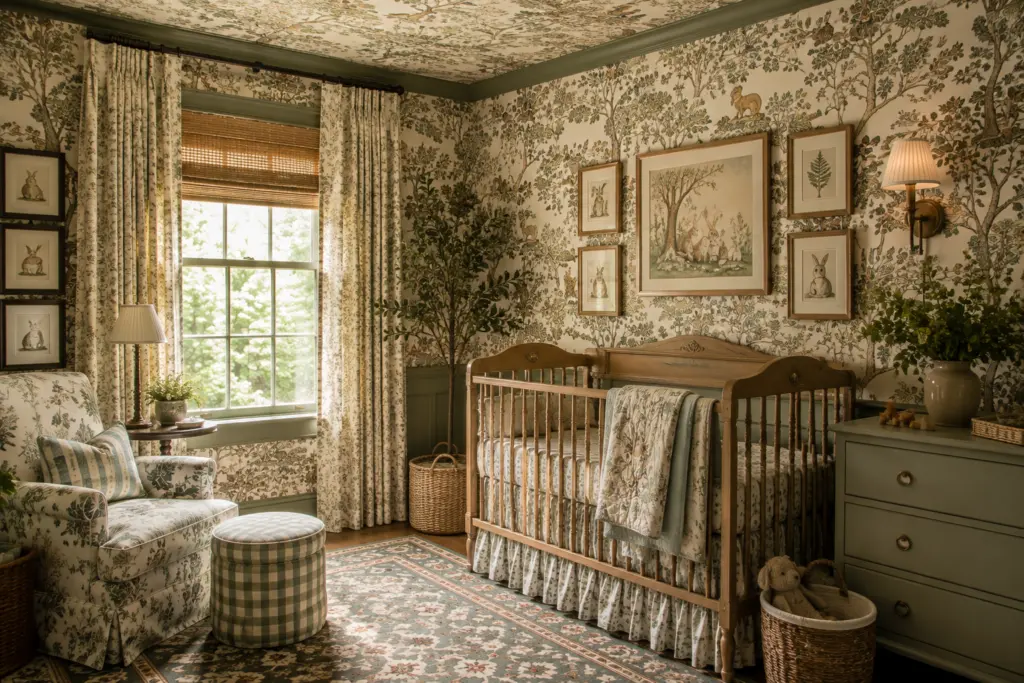
Pattern drenching doesn’t have to mean traditional florals.
A nursery can use:
- Woodland motifs
- Tiny checks
- Clouds
- Stars
- Animals
- Stripes
- Botanical prints
Layer a large-scale wallpaper with smaller patterns in the bedding and curtains.
For a calmer result, stay within one color family.
Soft sage, dusty blue, warm beige, muted yellow, and terracotta can create a gentle atmosphere without relying on plain white walls.
The beauty of pattern is that the room can grow with the child.
A sophisticated botanical wallpaper can work for a baby and still look appropriate several years later.
11. Pattern-Drenched Reading Nook
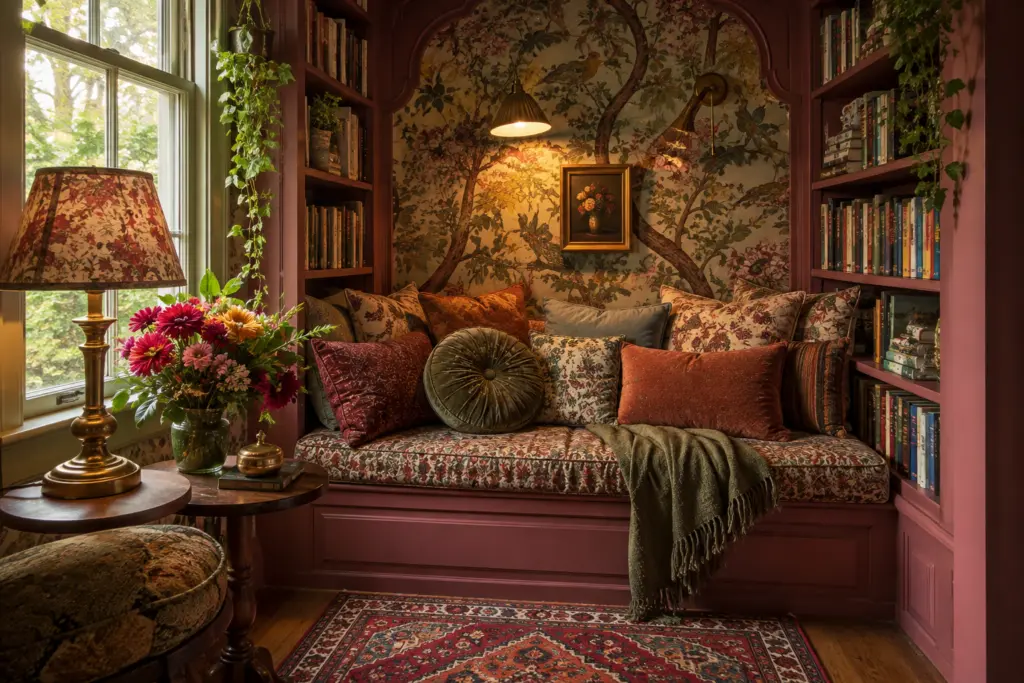
A reading nook is small enough to become experimental.
Imagine a built-in bench covered in patterned fabric, surrounded by wallpaper, cushions, books, and a small patterned rug.
This is where pattern drenching can become especially cozy.
Choose tactile materials such as:
- Velvet
- Linen
- Wool
- Bouclé
- Woven cotton
Pattern provides visual interest, while texture prevents the room from looking flat.
A small brass or antique-style lamp can finish the look.
The result should feel like a little world inside the larger home.
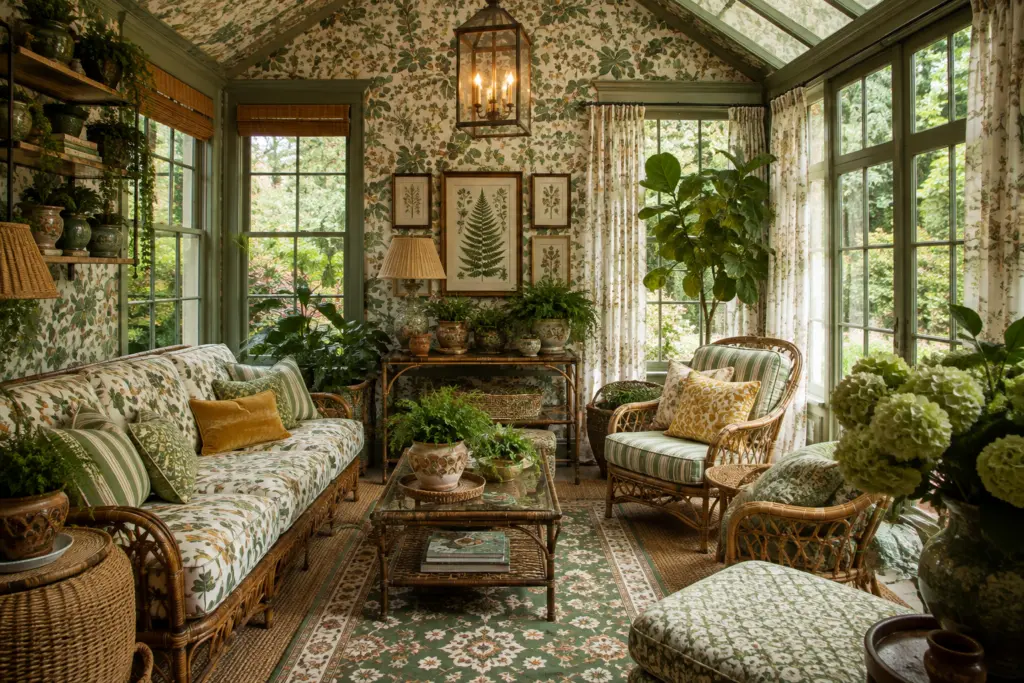
12. Pattern-Drenched Sunroom
Sunrooms are natural partners for botanical patterns.
Use leafy wallpaper, floral upholstery, striped cushions, and woven accessories.
The outdoor connection makes botanical motifs feel particularly natural.
You can also use:
- Rattan furniture
- Natural wood
- Woven baskets
- Linen curtains
- Indoor plants
Keep the base palette relatively earthy.
Greens, creams, browns, muted yellows, and terracotta work especially well.
The goal isn’t to make everything identical.
It’s to make the room feel as though every piece belongs to the same garden-inspired story.
13. Pattern-Drenched Guest Room
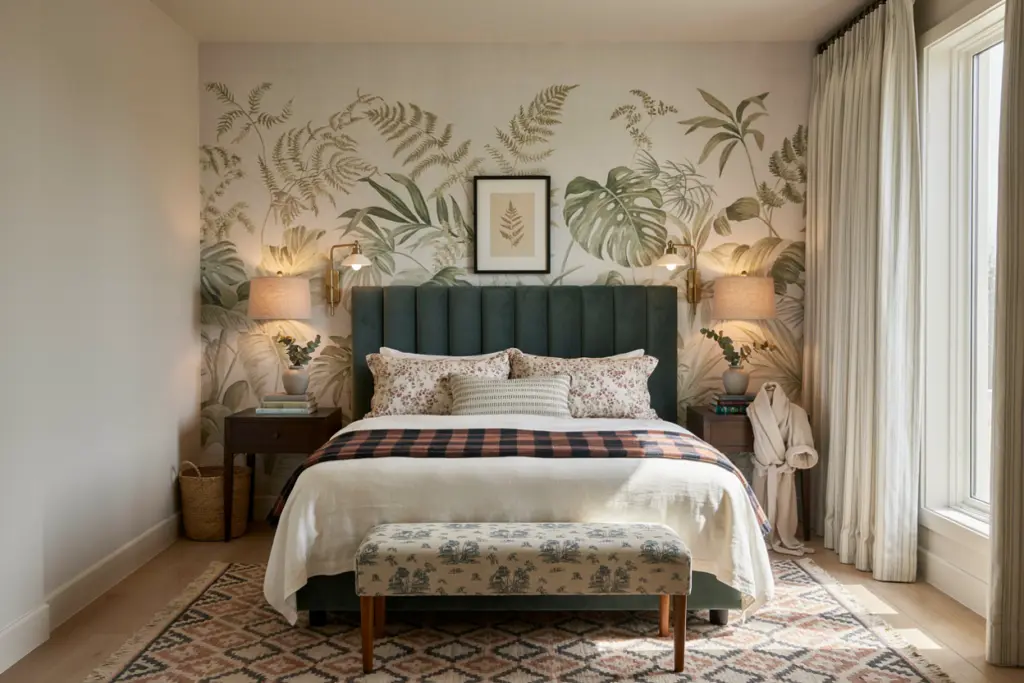
A guest room is another excellent place to experiment.
You can create a boutique-hotel atmosphere with wallpaper, patterned bedding, a fabric headboard, curtains, and an area rug.
The best guest rooms feel finished but not overly personal.
Choose classic patterns that appeal to a broad range of tastes:
- Botanical
- Small floral
- Plaid
- Stripe
- Geometric
- Toile-inspired motifs
Layering three related patterns can make an otherwise ordinary bedroom feel remarkably expensive.
14. Pattern-Drenched Staircase
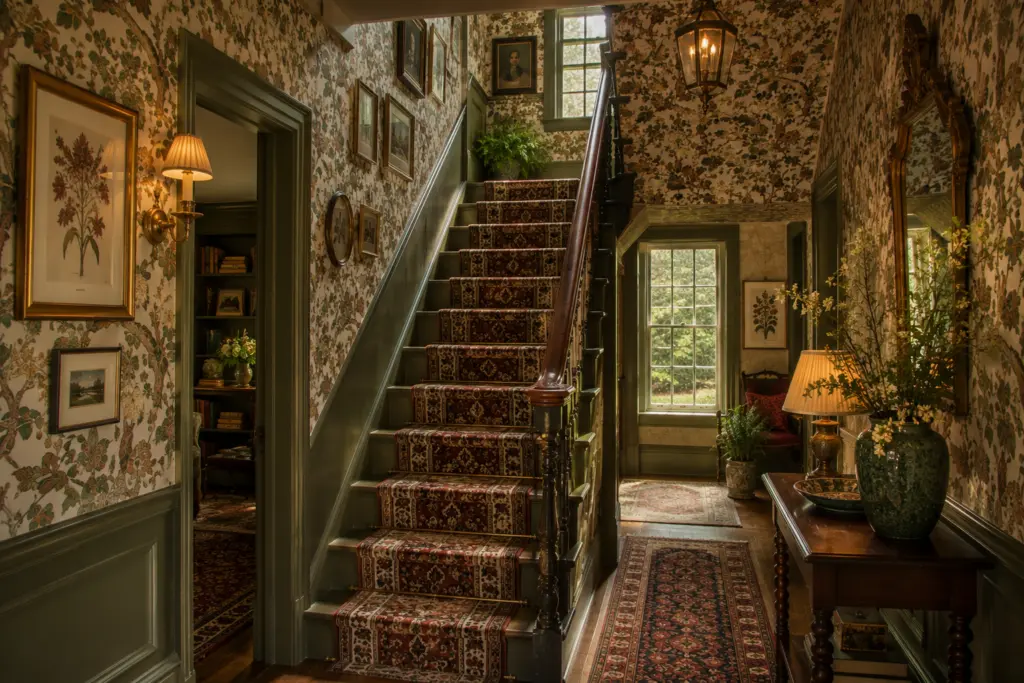
A staircase can become the visual backbone of the house.
Wallpaper the walls or ceiling.
Paint the trim in a complementary shade.
Add a patterned runner.
Then repeat one color in nearby artwork.
The staircase doesn’t need to be identical to the surrounding rooms.
Instead, think of it as a transition.
A bold runner can connect a neutral downstairs room to a more colorful upstairs bedroom.
This is particularly useful in homes where you want stronger personality without making every room maximalist.
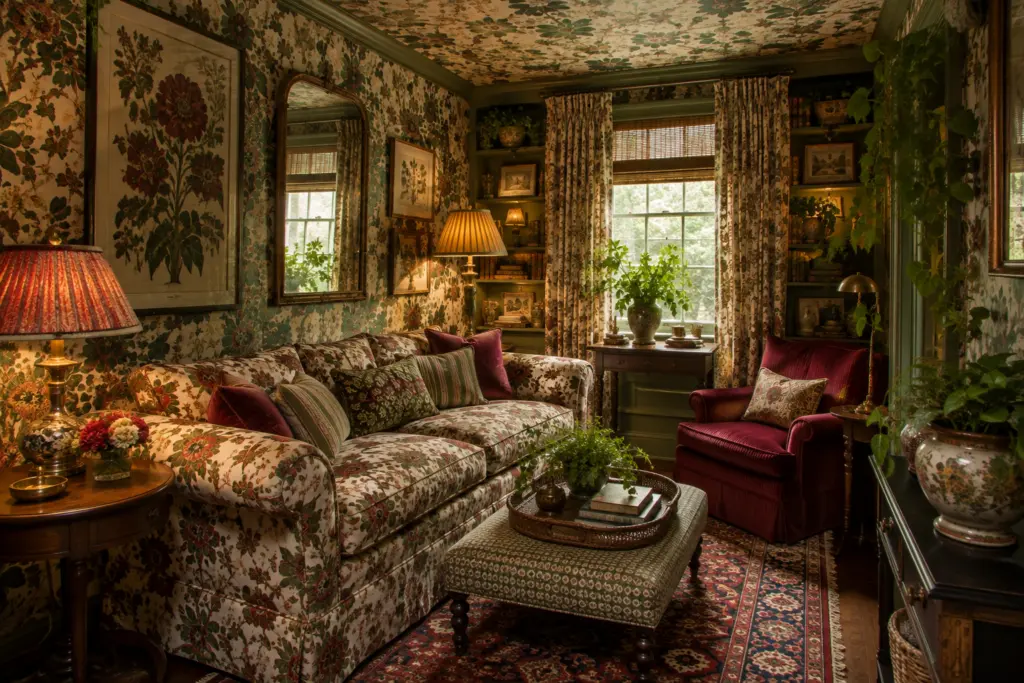
15. Pattern-Drenched Small Lounge
Finally, don’t overlook the small lounge, sitting room, or unused corner.
These spaces can handle intense pattern beautifully.
In a small room, try wrapping the walls in one wallpaper and using furniture in complementary patterns.
Because the space is compact, the design can feel intentional rather than overwhelming.
Use one visual anchor.
That might be:
- A large floral sofa
- Dramatic wallpaper
- An antique rug
- A painted ceiling
- A statement chair
Everything else should support it.
How to Create Pattern Drenching Without Making It Chaotic
Pattern drenching works best when there is an invisible structure underneath all the decoration.
Follow these rules.
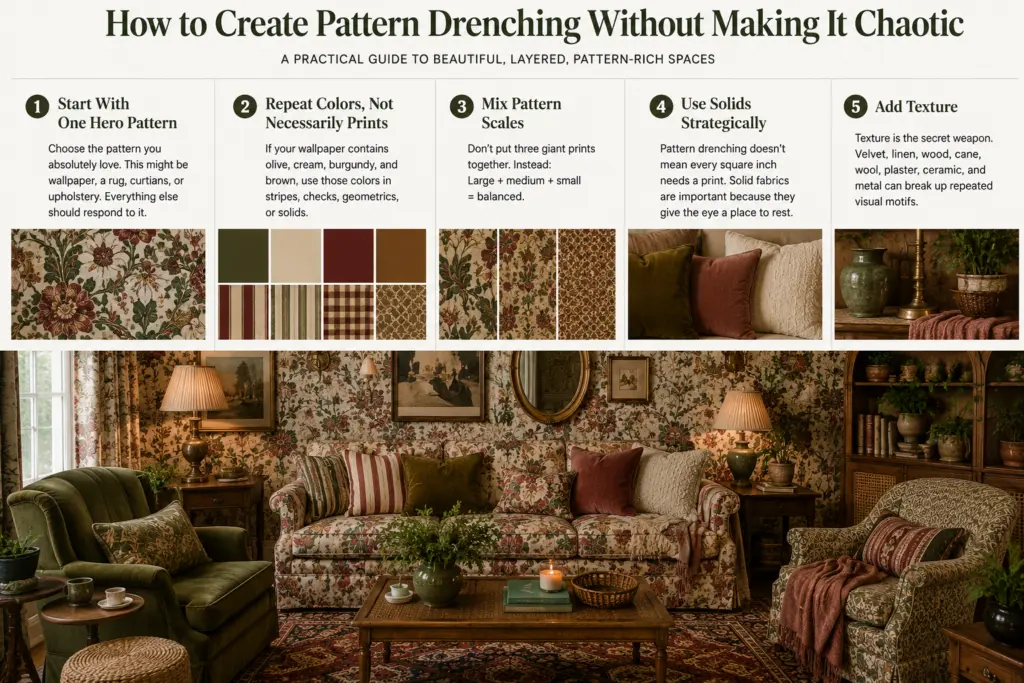
Start With One Hero Pattern
Choose the pattern you absolutely love.
This might be wallpaper, a rug, curtains, or upholstery.
Everything else should respond to it.
Repeat Colors, Not Necessarily Prints
If your wallpaper contains olive, cream, burgundy, and brown, you don’t need another identical floral.
Instead, use those colors in stripes, checks, geometrics, or solids.
Mix Pattern Scales
Don’t put three giant prints together.
Instead:
Large + medium + small = balanced.
Use Solids Strategically
Pattern drenching doesn’t mean every square inch needs a print.
Solid fabrics are important because they give the eye a place to rest.
Add Texture
Texture is the secret weapon.
Velvet, linen, wood, cane, wool, plaster, ceramic, and metal can break up repeated visual motifs.
The Biggest Pattern-Drenching Mistakes to Avoid
Using Too Many Equal-Sized Patterns
If every pattern is equally large and equally strong, nothing becomes the focal point.
Ignoring the Color Palette
Random colors can make even beautiful patterns look disconnected.
Matching Everything Exactly
A room where the curtains, sofa, cushions, and wallpaper are identical can look dated quickly.
Coordinate instead of copying.
Forgetting Lighting
Pattern looks completely different under different lighting conditions.
Always test samples during the day and at night.
Decorating Without Considering the Architecture
Pattern should enhance the room rather than fight its proportions.
Architectural Digest has also noted that designers remain divided on full color drenching: some see it as an enduring technique, while others warn that excessive saturation can flatten or overwhelm a space.
The same principle applies to pattern.
More isn’t automatically better.
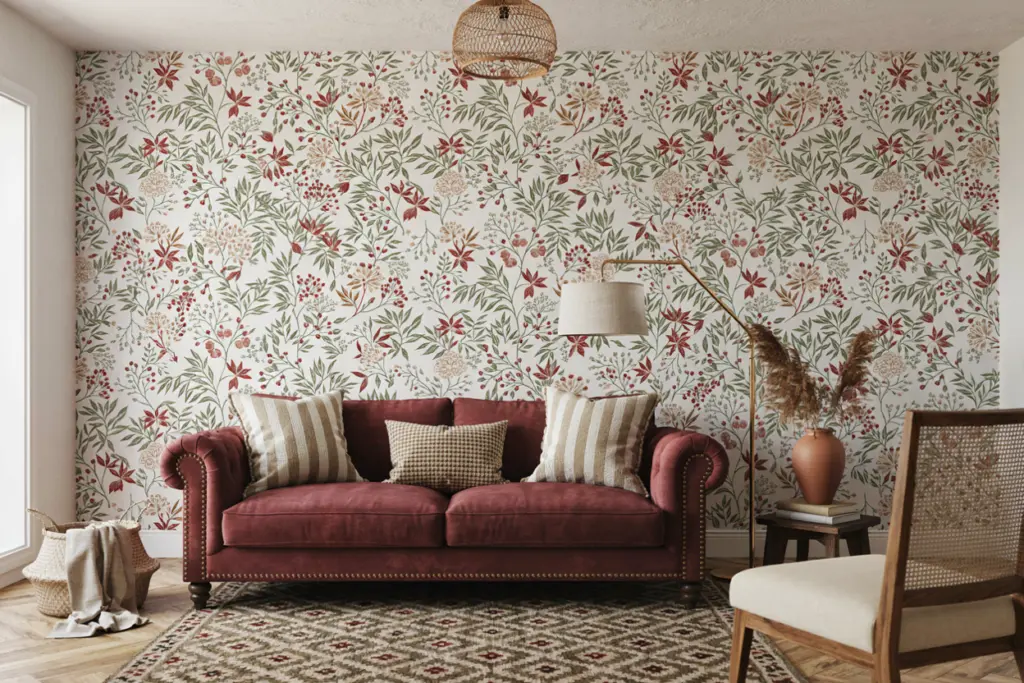
A Simple Step-by-Step Pattern-Drenching Formula
If you’re ready to try it, here’s an easy process.
- Step 1: Choose your hero pattern.
- Pick wallpaper, fabric, or a rug.
- Step 2: Extract three colors.
- Choose a dominant shade, secondary shade, and accent.
- Step 3: Choose a second pattern.
- Change the scale.
- Step 4: Add a third pattern.
- Try a stripe, check, or subtle geometric.
- Step 5: Introduce solids.
- Use plain upholstery or curtains where needed.
- Step 6: Add texture.
- Bring in wood, woven materials, velvet, linen, ceramics, or metal.
- Step 7: Repeat the accent color.
- Use it in artwork, lamps, cushions, or accessories.
- Step 8: Step back.
- Look at the entire room rather than individual pieces.
- If your eye has somewhere to rest, you’re on the right track.
FAQs
Is pattern drenching still trendy in 2026?
Yes. The larger design movement toward maximalism, richer colors, layered interiors, and all-over pattern continues to influence 2026 interiors. The technique itself isn’t completely new, but its current interpretation feels more relaxed and contemporary.
Can you pattern drench a small room?
Absolutely.
Small rooms, including powder rooms, reading nooks, and compact bedrooms, can be excellent places to experiment. Because the space is contained, a strong pattern can feel intentional and immersive.
Does pattern drenching mean everything has to match?
No. Matching is less important than coordination. Choose patterns that share colors, vary in scale, and complement one another.
What patterns work best together?
Florals, stripes, checks, geometrics, botanical motifs, and small-scale prints can work beautifully together.
A reliable combination is:
One large floral + one stripe + one small geometric.
What colors are best for pattern drenching?
There isn’t one perfect palette.
For a 2026-inspired look, consider earthy greens, burgundy, tobacco, ochre, chocolate, navy, smoky blue, and warm neutrals. These shades work particularly well with the current move toward richer, more expressive interiors.
Pattern drenching is less about following a decorating trend and more about changing the way you think about a room.
Instead of asking, “Where should I add a pattern?”, ask:
“How can the patterns in this room tell one story?”
That shift makes all the difference.
Start with one pattern you love. Pull out its colors. Mix large and small motifs. Add texture. Give the eye a few quiet moments. Then repeat those colors throughout the room.
You don’t need to cover every surface.
You simply need enough repetition to make the space feel connected.
From dramatic dining rooms and cozy bedrooms to tiny powder rooms and playful reading nooks, pattern drenching gives ordinary spaces an opportunity to feel deeply personal.
And perhaps that’s why the technique has such staying power.
The best interiors aren’t simply beautiful.